Build the Foundation: Why Metabolic Conditioning Is the Engine Room
When you walk into a CrossFit gym for the first time — or the hundredth time — the things that look impressive are at the top of the pyramid. The heavy barbell. The muscle-up. The athlete who moves like a machine through a workout that would stop most people cold. That's what gets shared on social media. That's what people think they're here to build toward.
What they don't see, and what most people underestimate, is what's underneath all of it. Because none of that exists without the engine that powers it. And this week, we're going longer on conditioning. I know some of you are going to feel that in your lungs before you feel it in your legs. That's the point. Here's why.
THE HIERARCHY OF DEVELOPMENT
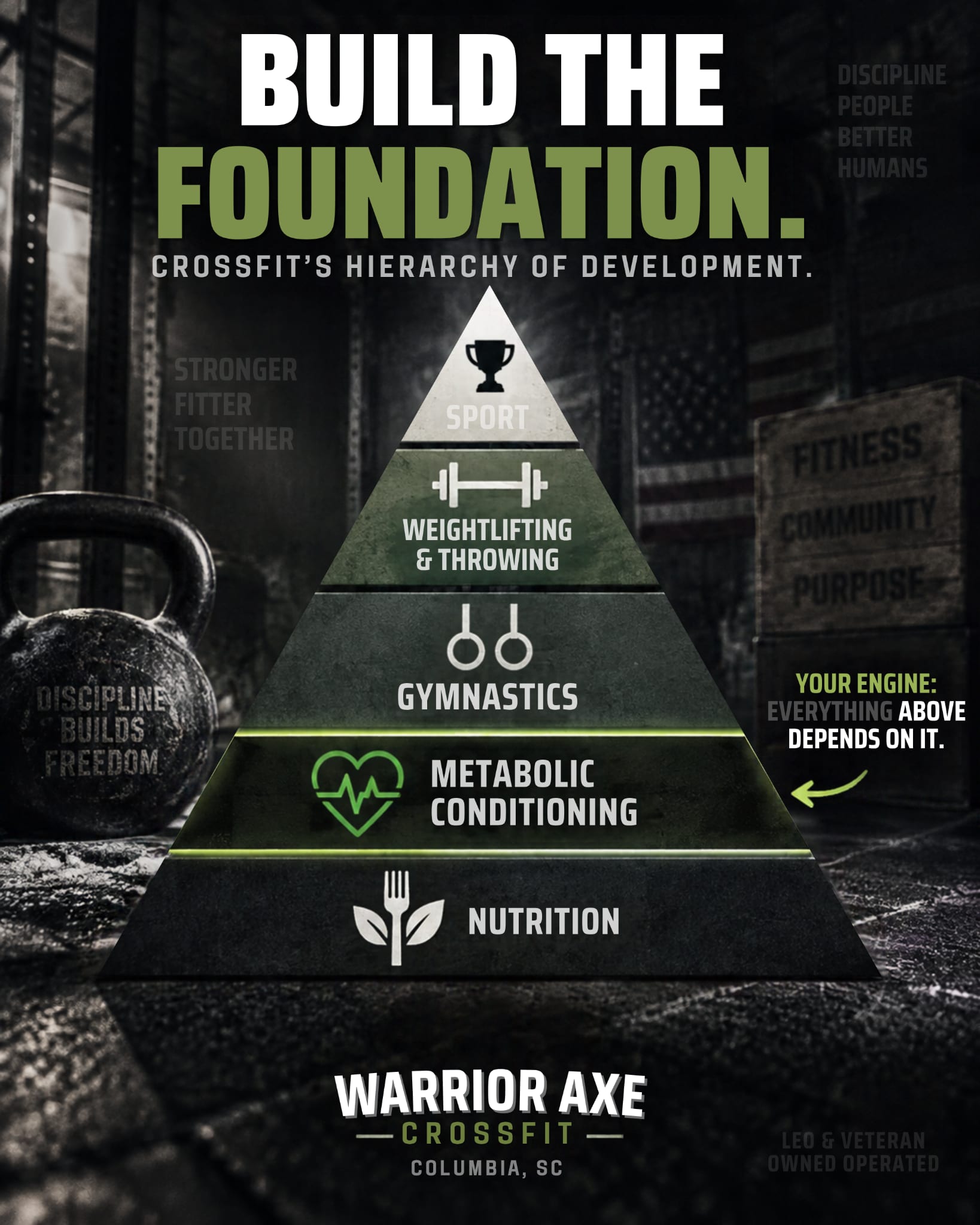
CrossFit's theoretical hierarchy of athletic development isn't arbitrary. It's a map of how the human body actually builds capacity — sequentially, with each level requiring the one below it to be stable before the one above it can develop properly. Greg Glassman laid this out not as a programming suggestion but as a physiological reality.
The pyramid reads from the bottom up:
NUTRITION → the biochemical substrate
METABOLIC CONDITIONING → the engine. Everything above depends on it.
GYMNASTICS → bodyweight movement, coordination, control
WEIGHTLIFTING & THROWING → requires both engine and gymnastics base
SPORT → the expression of all capacities under pressure
That arrow on the graphic isn't decorative. "Your engine. Everything above depends on it." That is a literal statement about how the body works, not a motivational tagline.
WHAT METABOLIC CONDITIONING ACTUALLY IS
Not "cardio" in the treadmill sense. Metabolic conditioning is your body's ability to gather, process, and deliver oxygen to working muscles — and to manage the metabolic byproducts of work efficiently. It determines how hard you can go, how long you can sustain it, and how fast you recover between efforts. That last one is the piece most athletes miss entirely.
WHY THE ENGINE POWERS EVERYTHING ABOVE IT
STAMINA
Muscular endurance — your ability to sustain repeated efforts — is aerobic work at its core. The athlete who can string together twenty unbroken pull-ups isn't just strong. Their aerobic system is delivering oxygen to those muscles fast enough to delay failure. Without the engine, strength becomes a one-rep ability.
STRENGTH
Recovery between heavy sets is aerobic work. Your cardiovascular system is what clears metabolic waste and restores the cellular conditions that allow you to lift again. An undertrained engine means longer rest periods, lower total volume per session, and slower strength adaptation over time. You can be strong in one rep and gassed by three sets.
GYMNASTICS
Bodyweight skills require precise motor control. Motor control degrades under fatigue. The athlete with a weak aerobic base hits metabolic fatigue earlier in a workout, and that's when technique breaks down. You are then practicing the movement while impaired. Repetition under fatigue doesn't build skill — it builds compensations.
WEIGHTLIFTING
The snatch and clean and jerk are technical movements requiring speed, timing, and positional awareness. All of those degrade when you're out of breath. The athlete who loses the engine in a conditioning workout starts missing lifts they can hit fresh — not because their technique disappeared, but because the fatigue state compromising the engine is compromising the technique.
SPORT
Whatever competition looks like for you — CrossFit Open, Hyrox, a local throwdown, just being the person who doesn't quit — the engine is what keeps the whole machine running when everything else is screaming to stop. The engine is what lets you keep expressing your capacities under pressure.
THE INJURY CONNECTION
Mechanics break down under metabolic stress. When you hit an aerobic wall, form goes — not gradually, but suddenly. The athlete who squats well for the first three sets and falls apart in the fifth isn't failing because their strength disappeared. The engine gave out, and the body started compensating to stay moving.
"The athlete doesn't get hurt because they lifted too heavy. They get hurt because they lifted too heavy while they couldn't breathe. Those are different problems with different solutions."
The pattern is consistent: athletes who push strength and skill development before the aerobic base is functional are constantly fighting an injury ceiling they don't understand.
- Form breaks under fatigue first — before you feel pain, mechanics degrade. The rep that hurts you is usually not the first bad rep.
- Overreaching without recovery capacity — athletes who skip the aerobic base load training stress they can't absorb. Recovery is aerobic work. Undertrain the engine and you're accumulating fatigue you can't clear.
- Skill practice under fatigue builds the wrong pattern — whatever you repeat under metabolic stress, you're encoding. If your snatch mechanics collapse at the end of a workout and you keep going, you're training the collapsed version.
STATS:
- Level 2 MetCon in Glassman's hierarchy — the base of all physical development
- 3× Higher all-cause mortality risk with low aerobic fitness vs. high (Mayo Clinic data)
- ↑ Speed Recovery between sets is aerobic — better engine = more work per session
- Every Level Above MetCon in the hierarchy requires it to be functional first
WHAT THIS WEEK'S PROGRAMMING IS ACTUALLY DOING
When you see longer conditioning work on the board, the instinct for a lot of athletes is to treat it as the warm-up tax — something you get through before the real training. That's backwards. The longer work is the real training.
You are not being punished with cardio. You are building the engine that lets you lift heavier, recover faster between sets, hold technique longer in a workout, and develop skills without practicing them in a fatigued breakdown. The longer conditioning sessions are the investment that pays out in every other session for the rest of the training cycle.
"Every athlete has a ceiling. For most people, that ceiling isn't strength. It isn't skill. It's the engine underneath both of them."
SIGNS YOUR ENGINE IS UNDERTRAINED
- Excessive breathlessness on moderate-intensity work that isn't particularly heavy or technically demanding
- Slow recovery between sets — you need significantly more rest than the prescribed interval to maintain quality
- Skill and technique breakdown in the back half of workouts, even on weights you handle well when fresh
- Performance cliff: strong for two to three rounds, then fall apart suddenly — not gradually
- Strength numbers that don't transfer to conditioning — big lifts in isolation, but can't sustain output under fatigue
If you recognize yourself in that list, the answer isn't a different strength program. It's the engine.
THE STANDARD
The hierarchy exists because the body is not randomly assembled. It has a development sequence. Skip it and you're building on a foundation that will eventually show its weakness — usually as an injury, a plateau, or a performance ceiling you can't explain.
Do the longer work. Push the engine. The metabolic discomfort is a different kind of hard, and it's the kind that builds the base everything else stands on.
THE BOTTOM LINE
The pyramid doesn't lie. Nutrition feeds the engine. The engine powers the gymnastics. The gymnastics supports the barbell. The barbell builds the athlete.
Skip the engine and you are not building an athlete. You're building a structure with a missing floor.
warrioraxecrossfit.com